

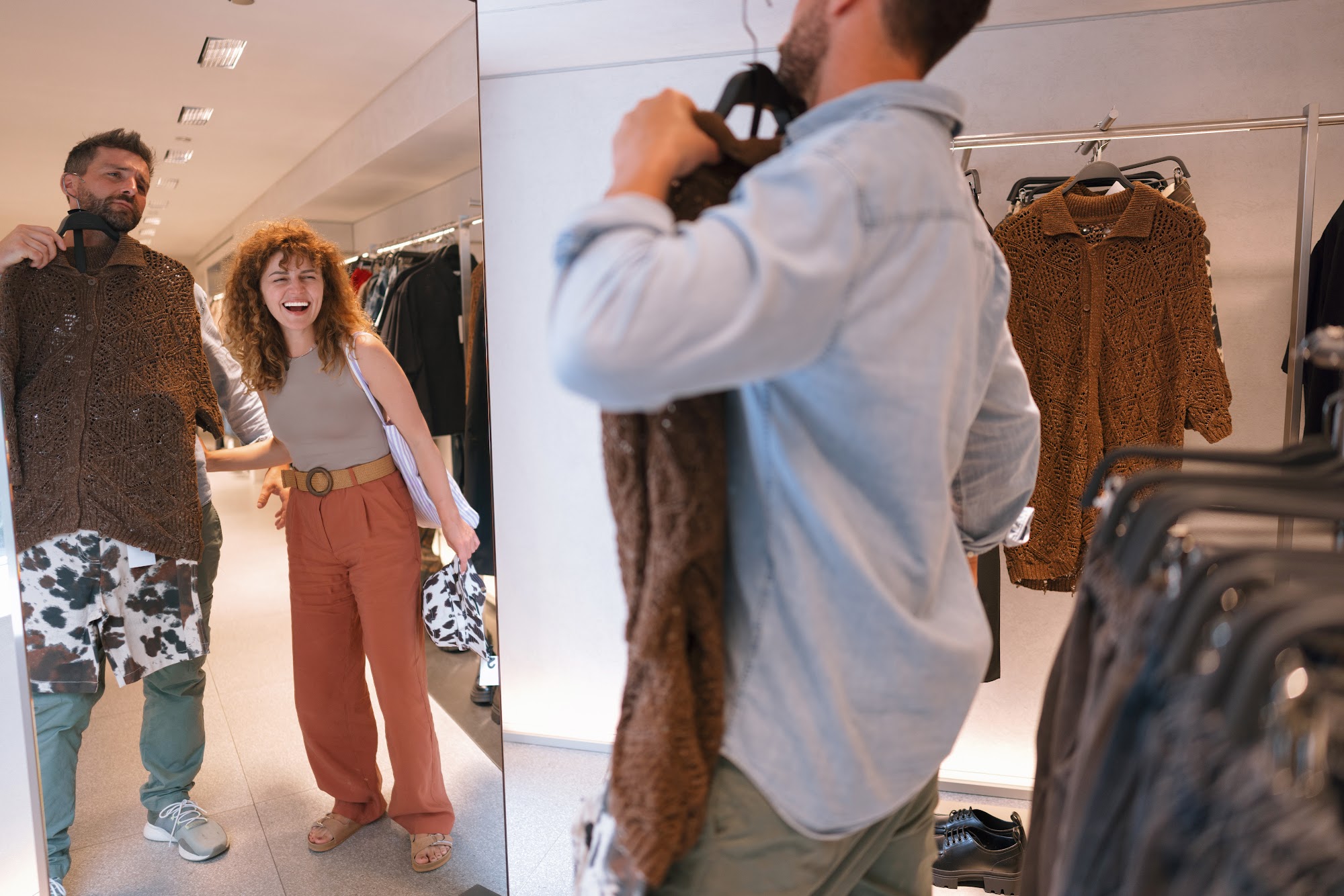

Picture a man in a clothing store on a Saturday afternoon. He has done everything a retailer could hope for. He walked in. He browsed. He picked up two pairs of chinos and a shirt, carried them to the back of the store, and took his trousers off in a small cubicle behind a curtain that doesn't quite close.
The chinos are too tight.
Now consider his options. He can get dressed again, walk out, hunt down the next size and come back. He can poke his head round the curtain in his socks and hope someone notices. Or he can quietly decide the chinos “weren't really him”, put his own trousers back on, and leave.
He leaves. Of course he leaves. Nobody in the history of shopping has wanted to be the person calling “Excuse me, have you got these in a 34?” from behind a curtain.
The moment of highest intent
Here is the odd thing. Retailers spend a fortune getting people through the door. Window displays, promotions, ads, loyalty points. Then the customer reaches the moment of highest intent in the entire building, the moment they are literally wearing the product, and the staff discreetly withdraw. Imagine a car salesman who gets you all the way to the test drive, hands you the keys, and goes to lunch.
We do this, I suspect, because we've confused the fitting room with a bathroom. It's private, so staff stay out. But customers don't want privacy from help. They want privacy from embarrassment. Those are two very different things, and the gap between them is where great sales go to die.
The mirror is a terrible salesperson
The mirror is scrupulously honest about all the wrong things. It tells you exactly what you look like and nothing at all about whether you look good. Very few fitting room decisions are really about the garment. They're about reassurance. People aren't only buying trousers, they're buying the confidence that these are the right trousers, and a mirror can't give you that. A person can.
What's needed is almost embarrassingly small. A knock. “How are you getting on? Want me to grab the next size?” A dozen words. No training budget, no new system, and the dead end becomes a second chance.
Will they? Can they? Do they?
So why don't more staff do it? With any behaviour on the shop floor there are really three questions. Will they? Can they? Do they, reliably?
The knock rarely fails on the second one. Almost anyone can say a dozen words. It fails on the first, because it feels like intruding, so they never try. That's a confidence problem dressed up as a skills problem, and you can't fix a confidence problem with a training manual.
Confidence gets them to knock the first time. Skill makes the knock land. Habit is what makes it happen at 3pm on a heaving Saturday when nobody's watching.
Meet, Close, Upsell
It helps to stop treating the fitting room as one moment and see it as the middle of a sequence. In GMCU terms, three things are going on.
Meet happens before the curtain. Ask what it's for. A wedding, a job interview, a first date. Now when you knock, you've stopped being a staff member checking up and become the person who knows it's for the wedding. Same knock, completely different meaning. Context turns an interruption into a service.
Close is the knock itself. The honest opinion, the next size, the “that colour's better on you than the navy.” This is where the sale lives or dies, and it takes about ten seconds.
Upsell comes last, and only works if Meet was done properly. Say “you'll want a belt with those for the wedding” to someone who already likes what they see in the mirror and it lands as a favour. Say the same sentence cold to a stranger and it lands as a pitch. The words haven't changed. The relationship has.
Start watching
The awkward truth for managers is that the fitting room is invisible by design. You can't coach what you can't see, and most stores have never once looked properly at what happens back there. So start watching. Score the knock. Notice who does it naturally and who hangs back. The ones who hang back aren't bad at their jobs. They just haven't been given permission yet. Give it, then keep watching until the knock stops being something they remember to do and becomes something they simply do.
Because the sale rarely dies in the fitting room because the customer changed their mind. It dies because nobody knocked.