



The best closing techniques for nice people sound like a normal conversation. The hard bit is saying them out loud.
A bloke in an orange hi-vis vest has been lying on a mattress for twelve minutes. His work boots sit at the foot of the bed, laces tucked in. Hands folded on his chest, eyes shut. He looks like a knight on a church tomb, if knights wore grey work socks.
It's Saturday in a small mattress shop. Priya stands at the end of the bed holding a notepad with nothing on it. She has asked "How are you finding it?" three times. The knight has said "Yeah, good" three times. Neither of them has a clue what happens next.
Eventually he sits up, relaces the boots and says he'll come back with his wife. Priya says "No worries!" in the voice of someone with quite a lot of worries.
Why nice people don't close
Priya spent four years waiting tables before this. "Are you ready to order?" She said it a few hundred times a shift. Nobody ever called her pushy. Put a few more zeros and a "sales KPI" between her and the customer and the very same question suddenly feels rude.
That's the psychology of pushiness. Nice people aren't scared of the question. They're scared of becoming that person: the one who hovers, who won't take a hint, who makes you feel cornered. So they overcorrect. They wait for the customer to close the sale themselves, which is a bit like waiting for your dinner guests to do the dishes.
Meanwhile the customer is waiting for her. A mattress is a big call, often shared with someone who snores. Nobody wants to announce the decision. They'd rather be asked, so all they have to say is yes.
A grown man does not take his boots off in a shop for a laugh.
Closing techniques for nice people
Pushy is asking before someone's ready. Asking when they're ready is good manners. Like the waiter who turns up just as you close the menu. Customers tell you when, just not in words. They go back to the same item twice. They ask about delivery. They take their boots off.
Then use a close that sounds like a person talking.
- The plain ask. "Reckon that's the one?" An easy question that lets them say yes without making a speech.
- The play-back. "So you wanted firm for your back, something that doesn't sleep hot. This does both. Shall we sort it?" It proves you were listening, which is half of what people buy from a person.
- The either-or. "Thursday or Saturday for delivery?" Picking a day is easier than deciding. Just check they've chosen the mattress first, or it feels like a leap.
Never apologise for the price
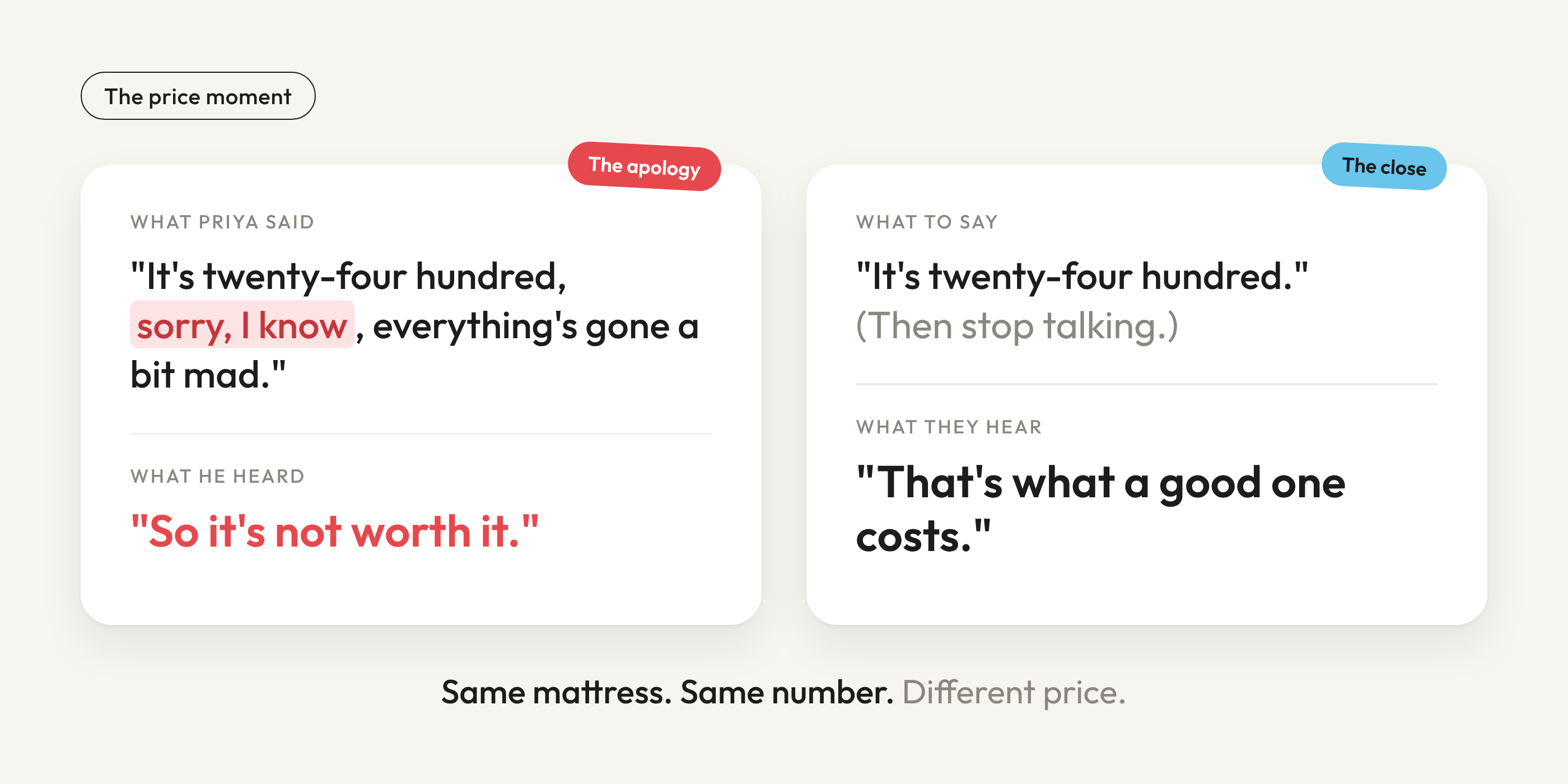
When the knight finally asked the price, Priya said, "It's twenty-four hundred, sorry, I know, everything's gone a bit mad price wise."
The price was fine. The apology told him it wasn't.
Customers take their cue on value from the person saying the number. Say it with a wince and twenty-four hundred sounds like a mistake. Say it plainly and it sounds like what a good night's sleep costs. Same mattress, same number, completely different price.
Nice people apologise because they want to be on the customer's side. You already are. You spent twenty minutes finding the right one. Apologising for the price is apologising for your own advice.
So say the number, then stop talking. It's a good mattress. It's allowed to cost money. Nice things....cost money.
After the yes, go quiet
Hear a yes and a funny panic sets in. You keep selling. You add "but have a think if you like". I wrote a whole confession about doing this at sixteen, when I'd sell the jacket and then, with firm dedication, unsell it.
Go straight to the boring stuff instead. "Great, let's get you sorted." Delivery day, the old mattress. Your job now is making the decision feel like a good one.
Making it stick
Priya's manager, Leanne, watched the knight leave. She didn't tell Priya to "close more", which helps about as much as telling a nervous driver to "relax!". She said, "Boots off for twelve minutes, mate. He was ready."
They agreed one move: when someone lies down trying out the mattresses for longer than an ad break on Prime, ask if it's the one.
Closing is the C in GMCU (Greet, Meet, Close, Upsell), the four moments the short video walks through. In Be Brilly, Leanne scores Priya's Close out of 10 and ticks what she saw, like "asked for the sale". The next score shows whether the coaching landed.
Leanne coaches it in order. Skill first: can Priya spot the moment and find the words? Then confidence: will she actually say them? Then attitude: does she ask every time, even with three people waiting at the counter?
A fortnight later a woman in netball gear kicks off her trainers on the same mattress and sighs. Priya gives it a hot minute, then circles back around with a friendly smile. "Reckon that's the one?"